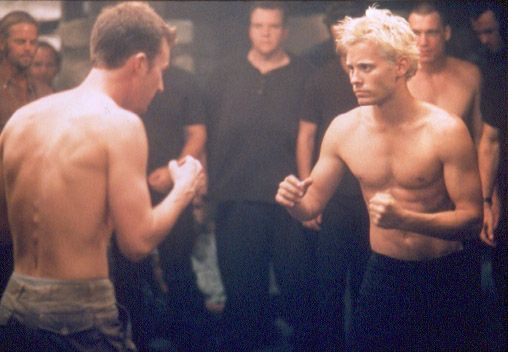
This blog covers everything related to self defense including but not limited to training, techniques, principles, martial arts, hand to hand combat systems, weapons, various scenarios, tips, sparring, psychology of combat, the list goes on. It is not restricted to just one fighting art but welcomes every reader regardless of experience to gain knowledge on self defense.
You've probably heard martial artists or self defense instructors say "size doesn't matter..don't use brute force in a street fight.." This isn't true. Size and strength absolutely do matter! The strategy for dealing with a much larger and stronger attacker is different from dealing with someone who is your own size. If you are a large and built person but don't know what to make of your physical abilities in self defense, this guide is for you.
1) Know yourself - In order for you to put your strength and size to good use, you must understand who you are. What are you good at? Lifting weights? Taking a hit to give a hit? Packing a powerful punch? Grappling? What do your work outs consist of? What about nutrition? The more information you can glean from your body, the more you can put it in a self defense situation.
2) Understand the source of power - Many people have the misconception that strength equals power. Why is it that stronger and larger attackers lose to much smaller people? They don't know where their source of power comes from. In this example, a Jiu Jitsu black belt easily overpowered a body builder who was much stronger and larger than him. What's the catch? Redirecting the flow of energy. If you don't know where your source of power comes from and how to use strength to your advantage, you will lose a fight involving dangerous opponents. Where does your source of power come from? The ground, the core (center of mass around the torso area), and momentum. Simply lifting weights and building outer muscles won't make you fit to fight. To be a good striker for example, you must learn how body mechanics work and how to develop your inner muscles responsible for powerful hits (see helpful link below). All the muscles in the world will not help you in a street fight. Only when you understand your source of power do your muscles serve you well.
3) Develop your own fighting abilities - Some people like to think speed and skill is superior to strength. This isn't necessarily true. Two can play at that game including you. How do you develop your own fighting prowess for combat? Recognize your strengths and weaknesses. Are you fast? Slow? Do you have longer reach? Tire too easily? Some ideas i've come up with are training to time your accurate punches and pack alot of power in each one. If your size and strength makes you tire more, learn how to invest your energy wisely. You may want to use momentum, gravity, balance, and strength in your attack strategy. Learning wrestling or some striking art like boxing may be useful to you. It's also beneficial to understand your attacking range and your opponent's. Doesn't matter how fast or agile your attackers are, they will eventually have to get close to you and that gives you an opportunity to strike. You also have to be mindful of how your investing your energy. If you face a faster opponent, all you have to do is move just a little bit to where you won't get hit instead of trying to dodge every attack. One powerful punch combined with superior strength timed correctly can bring devastating consequences (broken bones, damaged organs, possibly death). You could also slam your attackers to the ground and nullify their attacking ability using momentum which also would cause damage. If someone tries to knock or throw you over, lower your center of gravity then attack. This video of a wrestler taking on multiple opponents is an inspiring example of how strength could be applied in combat.
If you enjoyed this post, subscribe to my blog for updates, more advice, and exclusive content in the near future. I'm proud and excited to offer a FREE sample chapter of my E-book "Jeet Kune Do: How to build your own fighting system for self defense!" It's essentially a step-by-step guide on how to make your own self defense system suited to fit your own needs using Jeet Kune Do. If you would love to receive your FREE chapter of my e-book, click on the link below and share a post via. social media then it's yours for FREE! Be sure to also fill out the survey on the right and provide feedback on my blog. Leave questions, comments, and suggestions below. http://www.paywithapost.de/pay?id=7b715806-c78b-4bfd-badf-4242da2bf8f2 http://www.expertboxing.com/boxing-training/boxing-workouts/why-lifting-weights-wont-increase-punching-power
While many self defense instructors give their students instructions on how to beat the average attacker in the streets, you may on rare occasion run into an attacker who is more skilled than you. First of all, i would like to dispel the myth that a trained fighter would not want to fight you. Just look in the news and you'll see reports of UFC fighters beating their own spouses. You will find cases where martial artists have used their training to bully and intimidate other people such as in this video. Therefore someone who is more skilled than you has a reason to bully you especially when that person is misusing his or her skills for evil. I won't avoid the subject and rationalize it like others have by saying "just run away..." or "just don't get into a fight..." because those aren't effective self defense solutions when you are forced to respond to an attacking and arrogant boxer. Instead, i provide you with some principles and guidelines in surviving against an attacker who is better trained than you are.
The problem with calling someone a "skilled" fighter is that it's too vague of a term to be defined accurately. What criteria are we using to define skill? What exactly is a skill? According to the dictionary's definition, it's the ability to do something well. In the fighting context, skill is a very broad term. Someone could be skilled in striking quickly at close range but do poorly when attacking long range. Another person could be skilled in keeping distance with kicks but less skilled than someone else who excels at breaking through defenses. Someone could be great at packing power in their punches but lack proper timing and speed. Can someone be highly skilled in absolutely every aspect of fighting? No! Why? Because it would take too much time and energy to devote yourself to fighting with weapons, hand to hand combat, awareness, balance, speed, strength, grappling, groundfighting, timing, striking, kicking, evading, the list goes on at the uttermost level. Skilled does not equal invincible.
Let's assume that you've had some experience in hand to hand combat and face someone who is a better striker than you while the fight lasts longer than usual. You keep getting hit no matter what kinds of attacks you execute. How do you fight someone who is more skilled than you in that area? I give a two-fold response.
1) Avoid your opponent's strengths and exploit weaknesses - I'll take the infamous fight between Ronda Rousey vs. Holly Holm. If you followed Ronda's career, notice how she utterly dominated her opponents in close quarters combat. When she faced Holly Holm, she faced a formidable opponent. Why is that? Holly Holm attacked her from a long range. What led to Ronda's defeat? She couldn't adapt. This is a perfect example of where Ronda was skilled at close range fighting but Holly Holm had superior skill at long range attacks. Now you may object and say "well that's sport fighting, not self defense.." but that's besides the point. You apply the same principles in self defense. If your opponent is better than you at close range, you go long range. If your opponent strikes high, you strike low. If your opponent is stronger, you yield to his or her force and use it against him or her. If your opponent is more skilled than you in hand to hand combat, you use weapons. You may even choose to attack from the shadows. If your opponent is impatient, be patient and make him or her get frustrated. If your opponent gets angry too easily, anger him or her. By exploiting your opponent's weaknesses, he or she is bound to make a costly mistake.
2) Recognize patterns and break them - How do you beat a more experienced and skilled attacker? You go against your training. You learn to break patterns and use improper techniques when the time is right. Before you say "are you crazy?!? That's ridiculous!", bear with me. I've read an excellent article on beating a highly skilled opponent using anti-technique and looking for patterns in fighting (see link below.) After pondering this concept, it makes sense. When facing a more skilled opponent in striking, look for patterns and break them. If you were taught to punch in a specific structured and disciplined manner, you use an awkward structure of attack to deceive or confuse your opponent as it hits him or her. If your opponent has a habit of counter-attacking your attacks, you fake a punch then move to the side to evade the counter-attack and deliver a kick to the groin. If your opponent expects you to do that because you've been conditioning him or her to see a pattern in your moves, you change the pattern again then strike from a different angle and strategy.
Why does this work? In psychology, our minds tend to see patterns in random data. That's just the way we humans work. When we encounter something random that goes against our perceptions and beliefs, we are thrown off guard. Think about it. If someone spends countless hours practicing proper techniques in drills and sparring against opponents using the same or similar structure, do you think he or she would be prepared to attack someone who strikes with extraordinary form? I highly doubt it.
Bruce Lee explained this concept exceptionally well "empty your mind...be formless..shapeless..like water...you put water in a cup, it becomes the cup..you put it into a bottle, it becomes the bottle...you put it into a teapot..now water can flow or it can crash...be water my friend.." If you always confine yourself to rigid techniques and structure, your movements along with your thinking become mechanical. Liberate yourself from styles and techniques. Become like water. Be fluid and rigid when the time is right. Do the unexpected and adapt to your opponent's movements. Become one with chaos and order.
In conclusion, i leave you to ponder on these principles in your training. If you enjoyed this post, subscribe to my blog for updates, more advice, and exclusive content in the near future. I'm proud and excited to offer a FREE sample chapter of my E-book "Jeet Kune Do: How to build your own fighting system for self defense!" It's essentially a step-by-step guide on how to make your own self defense system suited to fit your own needs using Jeet Kune Do. If you would love to receive your FREE chapter of my e-book, click on the link below and share a post via. social media then it's yours for FREE! Be sure to also fill out the survey on the right and provide feedback on my blog. Leave questions, comments, and suggestions below. http://www.paywithapost.de/pay?id=7b715806-c78b-4bfd-badf-4242da2bf8f2
Since the rise of Brazilian Jiu Jitsu and MMA, groundfighting has become increasingly popular especially in the area of self defense. A very important question that people have asked is "should you take a fight to the ground?" Many self defense instructors bring up legitimate reasons why this is a bad idea such as the possibility of weapons, limited vision, vulnerability to attack, and multiple attackers. I can't give you a solid answer. All i can tell you is generally, you should not groundfight in self defense but that does not mean there are no exceptions. Here's some considerations you ought to take into account before you end up groundfighting:
1. Are there weapons involved? If so, don't go to the ground.
2. Are there multiple attackers? If so, don't go to the ground.
3. Are you running out of options in defeating a difficult opponent? Ground fighting may be a measure of last resort.
This does not mean that you can use any techniques or strategies found in BJJ or other grappling arts. Groundfighting in UFC and groundfighting in self defense should have two completely different objectives. If your going to make groundfighting in self defense then you must have certain objectives. For one you should not go for a takedown against an intensely difficult opponent as it exposes your head, neck, and back to attack. Instead wait until your opponent takes you down. Second, your objective should be to immediately seize the opportunity to immobilize your attacker primarily through a chokehold or using armbars for armbreaks. Remember the goal is not to make your opponent submit. It's a desperate measure to cut off the flow of oxygen so he/she can stop attacking you. You don't want to apply an armbar or a leglock for a submission to make your attacker tap out only to risk getting hit after you release the locks. You'll want to break limbs and move into a better position for attack. Forget about point systems and treating groundfighting like a sport. Focus on ending the fight as quickly as possible on the ground with a self defense mindset and then get up.
This is just my opinion. If you've tried striking and kicking with no success then groundfighting may be a measure of last resort but i don't recommend it as your first priority. What do you think? Should groundfighting be apart of self defense? Why or why not? Let me know in the comments below.If you enjoyed this post, subscribe to my blog for updates, more advice, and exclusive content in the near future. I'm proud and excited to offer a FREE sample chapter of my E-book "Jeet Kune Do: How to build your own fighting system for self defense!" It's essentially a step-by-step guide on how to make your own self defense system suited to fit your own needs using Jeet Kune Do. If you would love to receive your FREE chapter of my e-book, click on the link below and share a post via. social media then it's yours for FREE! Be sure to also fill out the survey on the right and provide feedback on my blog. Leave questions, comments, and suggestions below.
It's conventional wisdom among so many self defense instructors that when there's an attacker, you should always run. In reality, this is bad advice because you won't always have the luxury of running away from a threat. Even if you do, this won't guarantee that you will successfully get away from your attacker. Why is running bad advice for self defense?
First of all, you don't know how fast your attacker can run. If you somehow knew that you could outrun your attacker then running would be the best option but you don't know anything about who your facing. Second, you may not run fast enough to get away. If you don't run or work on cardio then how do you expect to outrun an attacker who's probably in better shape than you? He may have done more exercise from say evading police than you have. If you don't get enough exercise, you can bet that you will get taken down. Last, you may not have the time or distance to run. If your in a small building just a few feet away from an attacker, you won't be able to run to the door and open it so you can escape in time to escape. Let's say your on a moving bus or train when suddenly someone decides to swing at you? Where are you going to run? There's absolutely nowhere to go!
To illustrate my point with an example, just watch what happens when someone tried to outrun his attackers in the video below. From my unfortunate experience, i tried to outrun an attacker (a kid i knew from my neighborhood). Despite my fitness level from all the cardio i did as a child, he still caught up to me and took me down.
The other reason why running away is bad advice is because it's so vague. When self defense instructors say "just run away!", what does that even mean? There's absolutely no specifics as to how you can outrun your attackers. Sometimes the only way you can outrun your attacker is by attacking before you take off or after you win a fight.
If you do plan on outrunning your attackers, the questions you ought to be asking yourself should be - 1) Is there an escape route? 2) Do i have the time and distance needed to run away from danger? 3) What are the risks of running vs. the risks of fighting? 4) Where am i going to run?
The best advice i can give you if running is an option is to familiarize yourself with your environment. Make sure you have an escape route and that you don't give away your intention to your attacker via body language. Make sure that you are able to avoid your attacker by obstructing his vision and slowing him down if possible. If you do parkour, jumping over obstacles and climbing buildings could prove useful in getting away from danger. Finally have a safe zone such as a police station with cops inside or areas with a bunch of people. If there's people, that may discourage your attacker and give you enough time to get help.
If you enjoyed this post, subscribe to my blog for updates, more advice, and exclusive content in the near future. I'm proud and excited to offer a FREE sample chapter of my E-book "Jeet Kune Do: How to build your own fighting system for self defense!" It's essentially a step-by-step guide on how to make your own self defense system suited to fit your own needs using Jeet Kune Do. If you would love to receive your FREE chapter of my e-book, click on the link below and share a post via. social media then it's yours for FREE! Be sure to also fill out the survey on the right and provide feedback on my blog. Leave questions, comments, and suggestions below.
Baseball bats can cause serious damage when used as a blunt weapon. The force of the impact can break bone and cause other injuries especially if delivered to the head. Loss of consciousness or even death can occur. This is why it's important to understand how to defend yourself against an attacker wielding a baseball bat for a weapon:
1) Stay close to your attacker - Keep at a close distance just enough to where the bat can barely reach you. Don't move too far back or you will likely get hit.
2) Use a weapon - Get an improvised weapon such as a chair, a stick, anything that you can use to deflect strikes or deliver strikes to your attacker.
3) Move in and control the weapon - Timing is critical in these situations. The best time to close the gap is before or after an attack is made. Once you move in whether it's through a takedown or by other means, control the weapon. Alternatively, you could also control the arms holding the weapon.
4) Disarm - There's several ways you can disarm an attacker. You could use his own momentum against him by controlling his head and throwing him. You could use the bat as leverage and force it out of his grip. You could use a Judo throw. The overall aim is to disarm your attacker.
Additional tips:
* Don't try to block the bat with your arm - Some self defense instructors teach you should try to block the weapon with some part of your arm. This is a bad idea as the bat could break bone and damage tissue.
* Avoid the tip of the weapon - The most dangerous part of the bat is the tip. Once the bat has passed the centerline, it becomes safer to intercept your attacker.
* Don't hesitate - The only safe zones are outside of striking range or inside the grappling range. If your stuck anywhere between those two ranges, you will get hit. Keep in mind that your attacker can change the direction of the bat. Do not hesitate to close the gap between you and your attacker when the opportunity presents itself.
Practice your these principles especially timing and interceptions with a sparring partner using a foam bat.If you enjoyed this post, subscribe to my blog for updates, more advice, and exclusive content in the near future. I'm proud and excited to offer a FREE sample chapter of my E-book "Jeet Kune Do: How to build your own fighting system for self defense!" It's essentially a step-by-step guide on how to make your own self defense system suited to fit your own needs using Jeet Kune Do. If you would love to receive your FREE chapter of my e-book, click on the link below and share a post via. social media then it's yours for FREE! Be sure to also fill out the survey on the right and provide feedback on my blog. Leave questions, comments, and suggestions below. http://www.paywithapost.de/pay?id=7b715806-c78b-4bfd-badf-4242da2bf8f2
Self defense is the science of taking measures to protect one's own health and life. The problem with many self defense instructors is that they are too accustomed to teaching techniques and drills that are useless in the streets. You can practice techniques but if you fail to condition yourself to survive and adapt when they fail, you will get seriously hurt or killed. Effective self defense relies on fundamental principles more than techniques. That being said, i hope that my tips will help you in creating effective training.
* Learn unarmed combat - Whether it's martial arts or other unarmed combat systems, you will want to learn the fighting art that you are most comfortable with. To gain a better understanding of how armed combat works, it's helpful to understand how to defend yourself unarmed. There is no "one size fits all" to self defense. If you managed to throw a punch that your self defense instructor taught you and you ward off your attacker then good but what if you miss? By learning hand-to-hand combat, you will know how to deal with those situations.
* Work out with purpose - Don't just get muscular or physically fit, have a purpose for why you want to get physically fit and build muscles. Muscles may actually hinder your self defense training. Instead, focus on learning which muscles and physical abilities are useful in self defense. Learn which muscles are responsible for improving punching and kicking power then work those out. Work on balance, speed, agility, strength, stamina, and other essentials to self defense using various exercises.
* Choose quality practice over quantity - When i was a boy, i used to practice Karate high kicks but could never do them right because i didn't understand them. Don't just practice a technique without understanding. Understand what your practicing and why. Focus on using proper form and techniques as you incorporate it in your muscle memory rather than winning a sparring session. Push hard but not too hard. Train smarter not harder.
* Absorb what is useful and discard what isn't - As Bruce Lee said "absorb what is useful and discard what is useless. Add what is uniquely your own." There are many self defense "how to" guides teaching you how to defend yourself of a particular situation such as a gun disarm. While there are great techniques, there are also ones that are completely ineffective. There are many martial art techniques used in sports such as MMA which work well in those situations but when applied in self defense, they are useless. For example, using a Brazilian Jiu Jutsu armbar would work well in a competition but wouldn't work well in the street because you leave your whole body exposed to attack. As a student of self defense, you must have discernment. What techniques are best suited for self defense vs sport or training? You can pay a self defense instructor to teach you techniques but the questions you ought to be asking are - Is it simple? How simple? Are these techniques effective? How effective? Are they practical? How practical? Are they efficient? How efficient? Are they realistic? How realistic? Question the authority. Credentials won't mean much if you end up killed for using impractical techniques in a lethal circumstances. Therefore it is best to figure out for yourself as a fighter which techniques are practical and which aren't.
* Adapt to various situations - While you can learn techniques and practice sparring drills for many hours, you won't be able to apply them in self defense if you do not adapt. There are many variables that could alter the outcome of an attack on the street thus it's important to train in various situations without rehearsals. For example, if you've learned to disarm a gunman at close range then how would you respond to a gunman who pulled out his gun and fired from a longer distance? Adapting to every situation is crucial in self defense and you must be conditioned to it in training. If you practiced sparring with one partner then practice sparring with multiple attackers. Train sparring opponents with practice guns, knives, bats, etc. Spar with boxers and other types of fighters. Practice mock scenarios where you are forced to expect the unexpected and remember to keep certain principles in mind.
* Learn how to avoid conflict - Many self defense instructors teach the physical aspects of self defense but self defense can also be verbal, psychological, emotional, and mental. People will insult you and provoke you to attack so you must practice self control while not allowing your enemy to harm you with words. There are also cues and signs indicating a potential threat. Learning to diffuse a situation before it gets violent is more skilled than fighting itself.
I sure hope that these tips will greatly aid you in your training for self defense. If you enjoyed this post, subscribe to my blog for updates, more advice, and exclusive content in the near future. I'm proud and excited to offer a FREE sample chapter of my E-book "Jeet Kune Do: How to build your own fighting system for self defense!" It's essentially a step-by-step guide on how to make your own self defense system suited to fit your own needs using Jeet Kune Do. If you would love to receive your FREE chapter of my e-book, click on the link below and share a post via. social media then it's yours for FREE! Be sure to also fill out the survey on the right and provide feedback on my blog. Leave questions, comments, and suggestions below.
Why compliance may get you killed in self defense:
You've probably heard self defense instructors say "comply with everything an armed robber says and you'll survive, there's no need to fight..." but this is bad advice. You might survive or you might your throat cut or head shot anyways.
Logically, we would believe that compliance would ensure our safety if a criminal makes a demand but our ways of seeing the world differ from that of a criminal. Self defense instructors may neglect this and that's why it may cost you your life. Criminals are sick. They have little to no morals. They don't have a problem with killing you because your life means nothing to them. You have to evaluate what you value and what they value. What if they demanded you give them one of your loved ones? Would you comply to survive? An armed robber will not take any chances of you reporting to the police so they will likely kill you even if you comply. Criminals are out to fulfill all their sick fantasies - rape, murder, torture, theft, extortion, you name it. Would complying help you or others survive then?
The best way to deal with criminals is to think like them. If i decided i'm going to rob a bank, what measures would i take to prevent myself from getting caught? If i take someone hostage, how would i ensure that i can get away with a crime? By identifying the kind of criminal and motives you are dealing with, you are better prepared to make an assessment of the situation. Who are you dealing with? A gang? Armed robbers? The more you know, the better you will respond.
I've heard plenty of horror stories where victims of a violent crime ended up being killed despite doing everything that their attackers asked of them. My grandfather was stabbed by a gang member and was not even given a chance to comply. It only takes a split second for an armed robber to kill you.
What's the best course of action when someone threatens your life and makes demands? Deception. In my other post "use of psychology in self defense" (http://everythingselfdefense.blogspot.com/2016/06/use-of-psychology-in-self-defense.html), i explain the importance of using criminal psychology in self defense. In general psychology, we tend to see patterns in human behavior especially criminals. Don't give the perception that your strong because then that arises suspicion and cautiousness. Give the perception that your weak. The armed robber has probably committed tons of robberies thinking that because he has a weapon, his victims are compliant thus letting his guard down. He will not expect you to be trained in self defense and that gives you the advantage. Compliance is the most critical time to respond and surprise attack your offender via weapon disarms, strikes, etc.
There's a great chance you will get killed but it's a gamble between life and death. Research has shown that resistance to a criminal's personal demands was effective (see link below.) The most important thing to remember is that compliance is a means of creating opportunities either to escape or fight for your life.
If you enjoyed this post, subscribe to my blog for updates, more advice, and exclusive content in the near future. I'm proud and excited to offer a FREE sample chapter of my E-book "Jeet Kune Do: How to build your own fighting system for self defense!" It's essentially a step-by-step guide on how to make your own self defense system suited to fit your own needs using Jeet Kune Do. If you would love to receive your FREE chapter of my e-book, click on the link below and share a post via. social media then it's yours for FREE! Be sure to also fill out the survey on the right and provide feedback on my blog. Leave questions, comments, and suggestions below.
If you've read my other blog post on self defense against a knifeman (http://everythingselfdefense.blogspot.com/2016/11/self-defense-against-knife.html) then you should have a general idea of how to disarm a swordsman. Like self defense instructors teaching impractical fancy knife disarms, self defense instructors also teach fancy impractical sword disarms as well. I've taken some courses in sword fighting and had some experience in disarming during sparring sessions. Therefore, i will use what i know to help you defend yourself against a swordsman. While it is highly unlikely that you will come across situations such as these, there are several criminals who have used swords to murder innocent people and cops. In the case that it does happen, you should note several differences between swords and knives.
Knives are short range weapons, move quicker than swords, don't require committed attacks, used more for lightweight, etc.
Swords are long range weapons, move slower than knives, require committed attacks and blocks, heavier than knives, have longer handguards than knives, etc.
1) Be Vigilant - Pay close attention to your surroundings. Keep a safe distance from strangers. Recognize that it's much harder to conceal a sword than it is to conceal a knife. Your primary goal should be to avoid conflict and run.
2) Strike first - If you can't run away and your at a close distance then don't wait until the swordsman draws his/her weapon. It takes only a few seconds for a swordsman to get into a fighting stance, grab his sheath with one hand, grab the hilt of the sword with the other, pull it out, and point it directly towards you. That's plenty of time for you to close the distance and grab the handguard then do whatever attacks you want before you disarm the swordsman. Don't waste a single second.
3) Use a weapon - If the swordsman has already had his/her weapon drawn then it's time to improvise and get a weapon of your own if you are unarmed. Look for an object that the sword cannot cut apart and that would either serve as cover or an offensive weapon.
4) Move outside the line of attack - There are around 9 angles from which a swordsman can strike. Regardless, the same principle applies for any angle of attack. This video demonstrates the general idea of how to prepare for attacking a swordsman.
5) Control the blade - From a relatively safe position, you can briefly struck at the swordsman vision as a distraction as your other hand grabs the hilt then perform a disarm. You can redirect the blade several ways 1) Using a palm strike or slapping perhaps grabbing at the safe parts of the blade (sides, top, etc.) as you strike. 2) If the situation calls for it - you could grab the entire blade with one hand and the hilt with the other then disarm your attacker. Historical accounts actually affirm that with proper hand techniques, you could grip a stationary blade and not get cut. This is very risky so use with extreme caution. Do not use this on a moving sword as you are likely to get your hands cut off in the process. This would only work on a still blade. Do not grab the sharp edges of the blade with both hands and wrestle it out of the swordsman's hands as you will also get cut. Grabbing the sword would probably work best against a two handed swordsman as the previous video demonstrated. 3) You could alternatively push the attacker's arms away to redirect a strike before you control and disarm.
6) Disarm - For a one handed sword, it'd be best to throw your opponent off balance or immobilize via break his arm to render his attacking ability useless and make it easy to retrieve the weapon. For a two handed sword, you could tilt the blade until the attacker's grip is lost under pressure. Run away an dispose of the weapon where the attacker cannot reach it.
Several important key things that may save your life:
* Timing - As i've mentioned before, a swordsman has to commit to an attack or block. By that, i mean that the swordsman must use his/her body namely footwork in coordination with the arm and wrist to attack or defend. A swordsman cannot kill you unless he/she lunges forward or moves his/her arm to a certain degree before retreating to a defensive position. When is the perfect time to intercept? Before or after an attack is completed.
* Footwork - A swordfighter's stance is very essential in attacking and defending. By knocking the swordfighter off balance, you greatly reduce his/her attacking power and gain a grand opportunity to disarm him/her.
* Use your environment - Pay close attention to your surroundings. If you can get a sword stuck in a tree or car roof, a wall, that would be a great opportunity to strike at the swordsman and disarm him.
* Vision - A Swordsman's vision is vital in attacking and defending. Obstructing his vision with bright lights, sand, dirt, toxic substances, and other objects will briefly distract him/her thus giving you enough time to make your attack or retreat.
* Control - Grabbing hold of the swordsman's wrist and arm like you would a knife or the hilt is key to a successful disarm. Once you've gained control, you could drive the sword into the swordsman or take it away.
* Distance - It only takes some distance for the blade to reach you. A swordsman especially one with one-handed swords would have to extend his/her arm in order to strike, briefly leaving it vulnerable. This allows for you to control and isolate the offending arm (wrist + elbow).
* Accept pain - You will get cut mildly or severely but it's entirely possible for you to survive.
Mistakes to avoid:
* Don't try to "catch" the blade - I did an experiment with a friend where i'd kneel down then attempt to catch a downward sword strike. As soon as i got in position, he simply redirected his practice sword to a different angle and i was hit to the side instead. It doesn't take much for a swordsman to redirect a sword with just the flick of a wrist. It'd take a miracle for you to perform this move correctly.
* Don't move back too much - The more you move back, the more opportunities you give the swordsman to strike you. If you back up into a wall trying to avoid the sword, you will most likely get killed. You will want to be just close enough to avoid getting struck by the blade. Move around the swordsman to get into a position where you can strike and disarm.
I'd encourage you to spend some time practicing these techniques and principles with a partner using a fake sword. If you enjoyed this post, subscribe to my blog for updates, more advice, and exclusive content in the near future. I'm proud and excited to offer a FREE sample chapter of my E-book "Jeet Kune Do: How to build your own fighting system for self defense!" It's essentially a step-by-step guide on how to make your own self defense system suited to fit your own needs using Jeet Kune Do. If you would love to receive your FREE chapter of my e-book, click on the link below and share a post via. social media then it's yours for FREE! Be sure to also fill out the survey on the right and provide feedback on my blog. Leave questions, comments, and suggestions below.
Weapons are a great equalizer against any trained martial artist. They have the potential to seriously injure or kill in one attack if you are not careful then you could seriously end up hospitalized or dead.
While there are self defense guides teaching you a complex step by step guide on how to defend against someone armed with a knife, the reality of the situation may not allow you to perform those techniques. A frenzied attacker would ideally charge at you with a series of stabs and cuts as opposed to just one fatal stab. You won't have time to react quickly enough against a very mobile attacker. Therefore, it is best to resort to simplicity. There are some fundamental principles that will ensure a successful disarm against someone attacking you with a knife within a short amount of time. The basic principles are as follows:
* Control
* Close the gap
* Takedown
* Disarm
1) Know the signs - Be aware of the people around you. Don't get too close to a complete stranger. In many cases, knifemen ambush you with a flurry of attacks. Have a plan in motion. Are you in a reasonable distance to escape via running? Are you in a confined area? Are there cars? People? Police nearby? Cameras? How will you respond against a knife attack? Be aware of your surroundings and a potential attacker. This video shows you different types of knife attacks.
2) Determine the attacker's intent - Is your attacker trying to kill you or rob you? If your attacker gives you a chance to save your life then take it by all means. If however your attacker is bent on killing or kidnapping you then it's time to respond.
3) Accept the likelihood of pain - If unarmed, your likely to get stabbed or cut. Regardless, many have survived knife attacks through willpower. The more mentally prepared you are for pain, the more chances you have of surviving. Don't give up even if you have been struck once. Keep fighting until you can no longer fight.
4) Use a weapon - What weapons are at your disposal? Sticks? Pipes? A sword? Chairs? A gun? Use them as an equalizer to a knifeman. Remember anything can be used as a weapon - sweaters, shirts, glass, sand, a wall, a door, a tree, etc. By using weapons, you increase your chances of survival than if you were unarmed.
5) Know which techniques are practical - There are many martial arts and self defense instructors that teach impractical disarming techniques in complex steps. As i mentioned before, your not going to have time to perform them. It doesn't take much for a knifeman to move back and move his knife with his wrist then stab you from another angle. Keep things simple and follow the basic principles mentioned above to guide you to proper disarming techniques. I've found an excellent video by Martial Arts Tutorials and Fight tips explaining how easy it is for a knife attack to occur. It also explains how to deal with a knifeman using the fundamental principles of situational awareness, closing the gap, timing, speed, controlling and isolating the weapon, and so forth.
6) Move around the direction of attack - When a knifeman strikes at you, he/she will likely move in to strike. When that happens, move to the side or behind the attacker where he/she is at a vulnerable position. The more distance you create by moving back, the more likely you are to get struck.
7) Control the offending limb - Once you've gotten in a position to disarm the knifeman, control the knifeman's arm by grabbing the wrist and elbow quickly. Controlling the elbow and wrist with both hands is vital to disarming an attacker. If you only grab hold of either the knifemans's wrist or elbow, it's very easy for the knifeman to pull away or rotate their arm to strike you and attack you with the other free hand.
8) Takedown the knifeman - Kicking the knees or behind them or sweeping his or her legs off balance as you drive your bodyweight with your knees on your attacker's back will ideally make disarming easier. It's more efficient to deal with one limb for a disarm than to deal with a knifeman's kicks, headbutts, and other hand if he/she were standing up. The faster you can disarm a knifeman, the better.
8) Immobilize a knifeman - Some self defense videos suggest attacking a knifeman and struggling for the weapon. While you may be forced to strike back in some cases, it will not work in others as the knifeman may be drugged to resist pain. You should focus on immobilizing an attacker by breaking or momentarily stunning the arm holding the knife, making a knife disarm easier. Doesn't matter how tolerant to pain a knifeman is, he/she cannot attack you effectively with a broken or stunned limb.
9) Retrieve the knife - Once the knife is in your hand, toss it into an area where your attacker will not be able to reach such as an ocean, a rooftop, etc. Land a few blows if your attacker is still bent on attacking you then run away to safety.
Key points to keep in mind:
* Focus - Your focus should not be on the knife. Your focus should be on the person controlling it. Control and attack the knifeman in order to eliminate the threat.
* Timing - Perfect timing is critical in disarming a knifeman. You must respond quickly. By timing your hands to grab hold of your attacker's offending arm and controlling, you are better able to disarm him or her.
* Control the distance - Always control the distance between you and an attacker. Never allow him or her to get too close or too far away. If you have difficulty controlling the offending arm then keep your distance with kicks to the groin or knees and strikes to the head. Don't kick above the waist as it leaves your legs exposed to the knife. Even keeping a few centimeters away from a knife can mean the difference between life and death.
* Use your environment - Don't get so caught up in disarming your attacker that you forget about your surroundings. Use the environment to your advantage. Pushing the knifeman off a bridge or an ocean could be your opportunity to survive an attack. Just pushing a knifeman into a brick wall could cause him/her to suffer a concussion or momentarily knock him/her off balance, allowing you the perfect opportunity to close the gap for a disarm. Using a barrier between you and a knifeman may also help. There's many ways you could use the environment to potentially disarm or even escape from a knifeman.
* Vision - A knifeman's vision is important. Blinded or distracted by other objects will serve to your advantage. Gouge and strike at your attacker's eyes. Do whatever you can to get him/her's focus away from the weapon.
* Various knife attacks - There are different kinds of knife attacks from behind, front, side, in different forms such as stabbing or slashing at high speeds. The knifeman may openly or stealthily attack you. Be prepared to adapt to each one.
* Angle of attacks - Being cautious of the angles and trajectories of a knife attack allows you to evade or move to a safer position where you can either control or attack your opponent.
* Distractions - Whether your attacker is an armed robber or a murderer, distractions are key in creating an opportunity in attack. Communicating with your attacker is also a means of creating a brief distraction before you commit to an attack or disarm.
Spend some time practicing disarming techniques and principles with a partner in various scenarios with a rubber knife. If you enjoyed this post, subscribe to my blog for updates, more advice, and exclusive content in the near future. I'm proud and excited to offer a FREE sample chapter of my E-book "Jeet Kune Do: How to build your own fighting system for self defense!" It's essentially a step-by-step guide on how to make your own self defense system suited to fit your own needs using Jeet Kune Do. If you would love to receive your FREE chapter of my e-book, click on the link below and share a post via. social media then it's yours for FREE! Be sure to also fill out the survey on the right and provide feedback on my blog. Leave questions, comments, and suggestions below. http://www.paywithapost.de/pay?id=7b715806-c78b-4bfd-badf-4242da2bf8f2

 If you enjoyed this post, subscribe to my blog for updates, more advice, and exclusive content in the near future. I'm proud and excited to offer a FREE sample chapter of my E-book "Jeet Kune Do: How to build your own fighting system for self defense!" It's essentially a step-by-step guide on how to make your own self defense system suited to fit your own needs using Jeet Kune Do. If you would love to receive your FREE chapter of my e-book, click on the link below and share a post via. social media then it's yours for FREE! Be sure to also fill out the survey on the right and provide feedback on my blog. Leave questions, comments, and suggestions below.